Edu-Dutch teaches Dutch online through live courses and a self-paced learning platform. For its small team, the website is where courses are sold, accessed and taught, so it has to keep working while the school grows.
A new foundation for the school
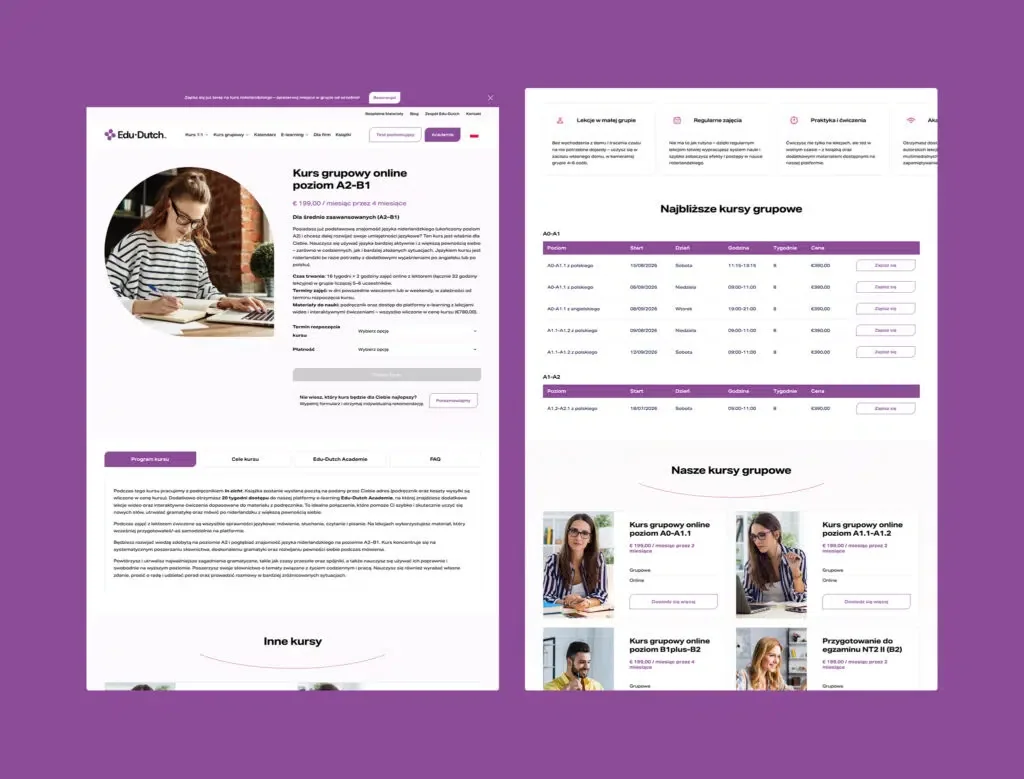
The school’s previous setup combined an Elementor website with a separate course platform on WebToLearn. Edu-Dutch wanted one place to sell and teach, with room for different offers for Polish- and English-speaking students. That meant more than translating the same pages.
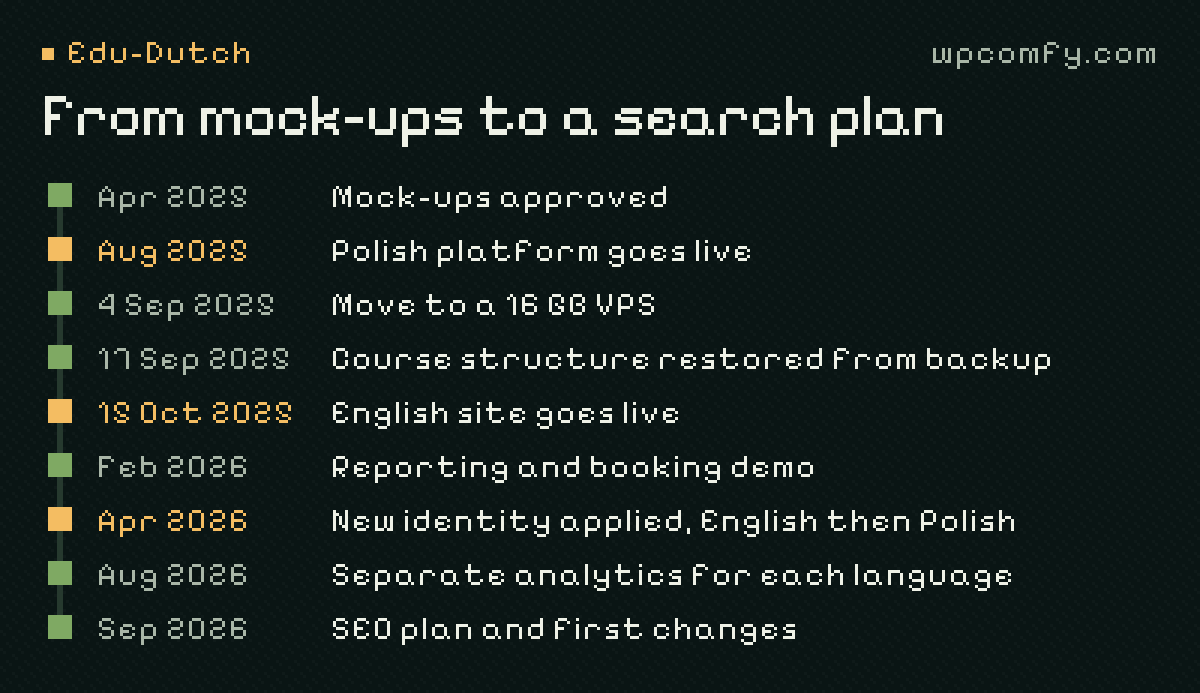
Jakub designed and built a WordPress platform on LearnDash and WooCommerce. The mock-ups were approved in April 2025, and the Edu-Dutch team recreated its courses on the new platform. The Polish site went live at the turn of August and September 2025, the English site on 15 October. A Dutch version followed later.
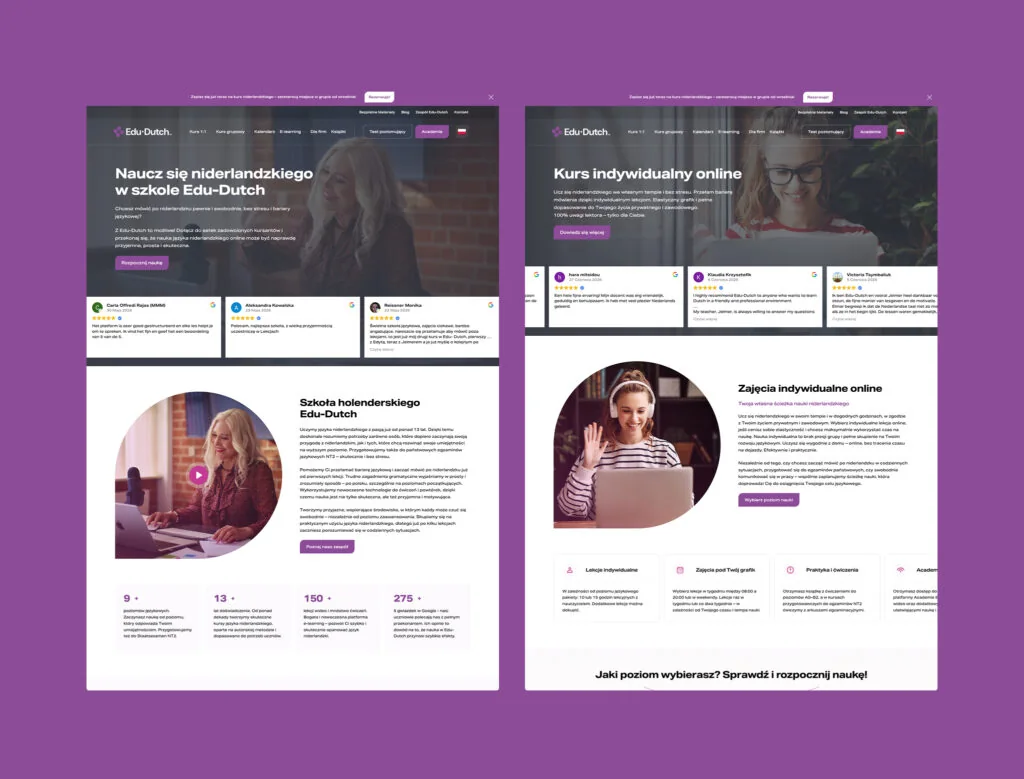
Launch was the start of the work, not the end of it.
One point of contact for care and development
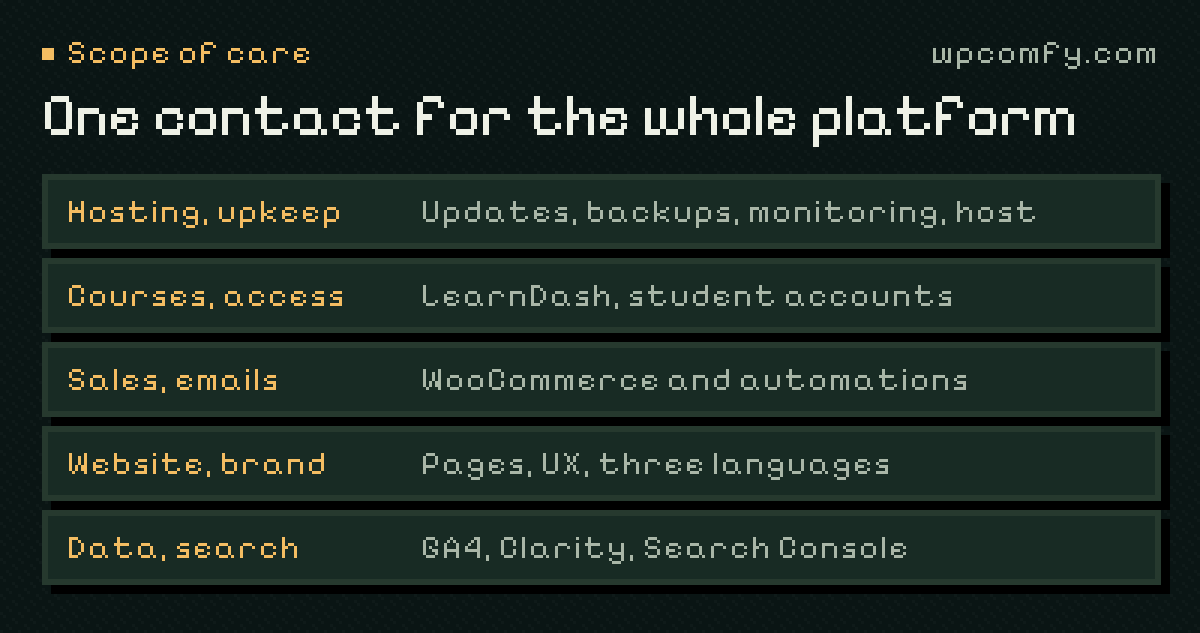
Edu-Dutch has one technical partner who knows how its website, courses and sales process fit together. The ongoing work covers:
- WordPress updates, backups, monitoring and functional checks;
- troubleshooting across the website, the learning platform and the purchase journey;
- direct contact with the hosting provider;
- UX and UI improvements, Google Analytics and Microsoft Clarity reviews, and SEO recommendations;
- new features and changes to existing workflows.
Requests, feedback and decisions are kept in Asana. Routine care keeps the platform steady; development is prioritised and agreed around what the school needs next.
Choosing hosting around the business
Early in the Polish platform’s life, the shared hosting plan was struggling. The discussion pointed to available memory as the limit, and the English and Dutch sites were still to come.
Jakub compared three routes: a higher tier with the existing provider, a server the school would have to administer itself, and a VPS with provider support. He weighed the monthly cost, the resources, who would look after the server and how easily more sites could be added. He also explained why a bigger package in the same shared category was not the same as a different server: more storage would not fix a memory problem.
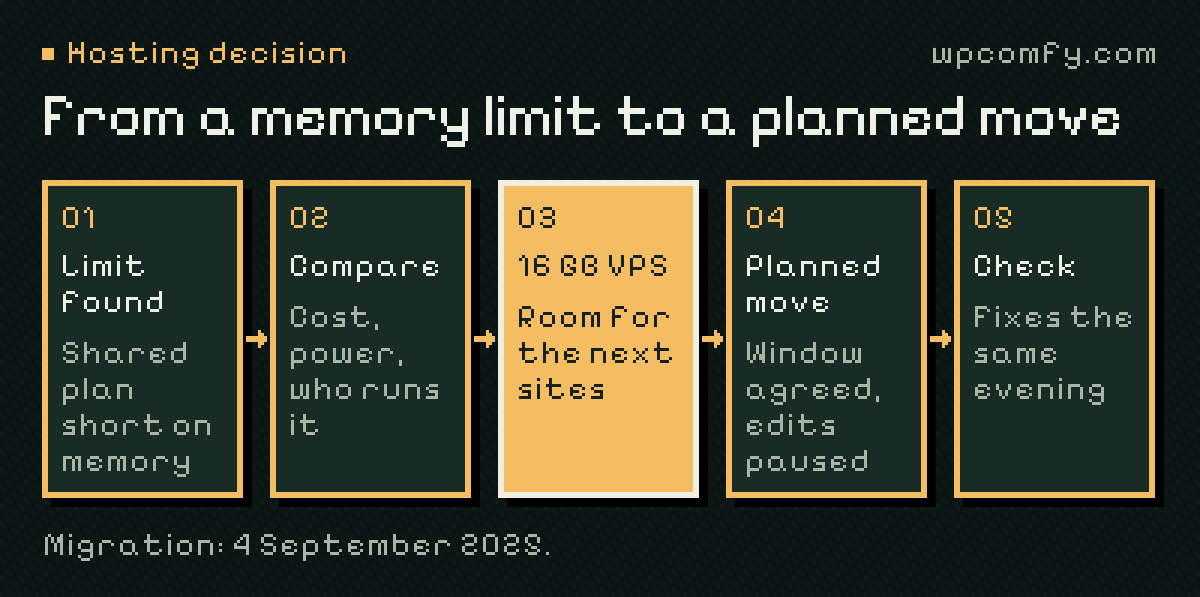
The school chose a 16 GB VPS at SEOHOST. On 4 September 2025 the move ran in an agreed window: DNS changed, site edits paused, platform transferred. That evening Jakub asked Kinga to check the site. She reported that it felt noticeably faster and that her checks passed, and flagged a student-panel issue on iPhone, which was fixed in the same exchange.
Outcome A working platform on hosting chosen with the next language versions in mind. The decision, the migration and the follow-up were handled as one piece of work.
When a backup has to become a recovery
In September 2025 a change to the course settings disrupted the learning structure. The most recent restore point already contained the problem, so an earlier one was needed.
Jakub coordinated the restore with the hosting provider using that earlier backup. On the morning of 17 September Kinga confirmed that everything was back as before. Two orders placed after the restore point were then handled by hand, so those students still received their accounts and emails.
Outcome The course structure came back, and so did the details a restore leaves behind. Recovery meant choosing the right restore point and following it through, not just pressing “restore”.
From payment to course access
Selling an online course takes more than a successful payment. The student also needs an account, access to the right course and the right emails.
When some purchases did not give students access, Jakub traced it to the order status. The automation ran when an order was marked “completed”; orders left in “processing” did not trigger the same steps. He worked through the affected orders and created the missing accounts and emails, and Kinga confirmed they had arrived. A change to the automation was planned so that access would not depend on a manual status change.
Outcome Students got the access they had paid for. The investigation followed the whole journey, from the WooCommerce order to the course.
Building tools for a sales opportunity
The partnership also left room for new features, including meeting bookings and a custom reporting plugin for the learning platform.
In February 2026 a large company asked Edu-Dutch for an offer, and the school wanted to show what its platform could do. Jakub installed the reporting on the English site and set up a booking demo so the team could record a walkthrough.
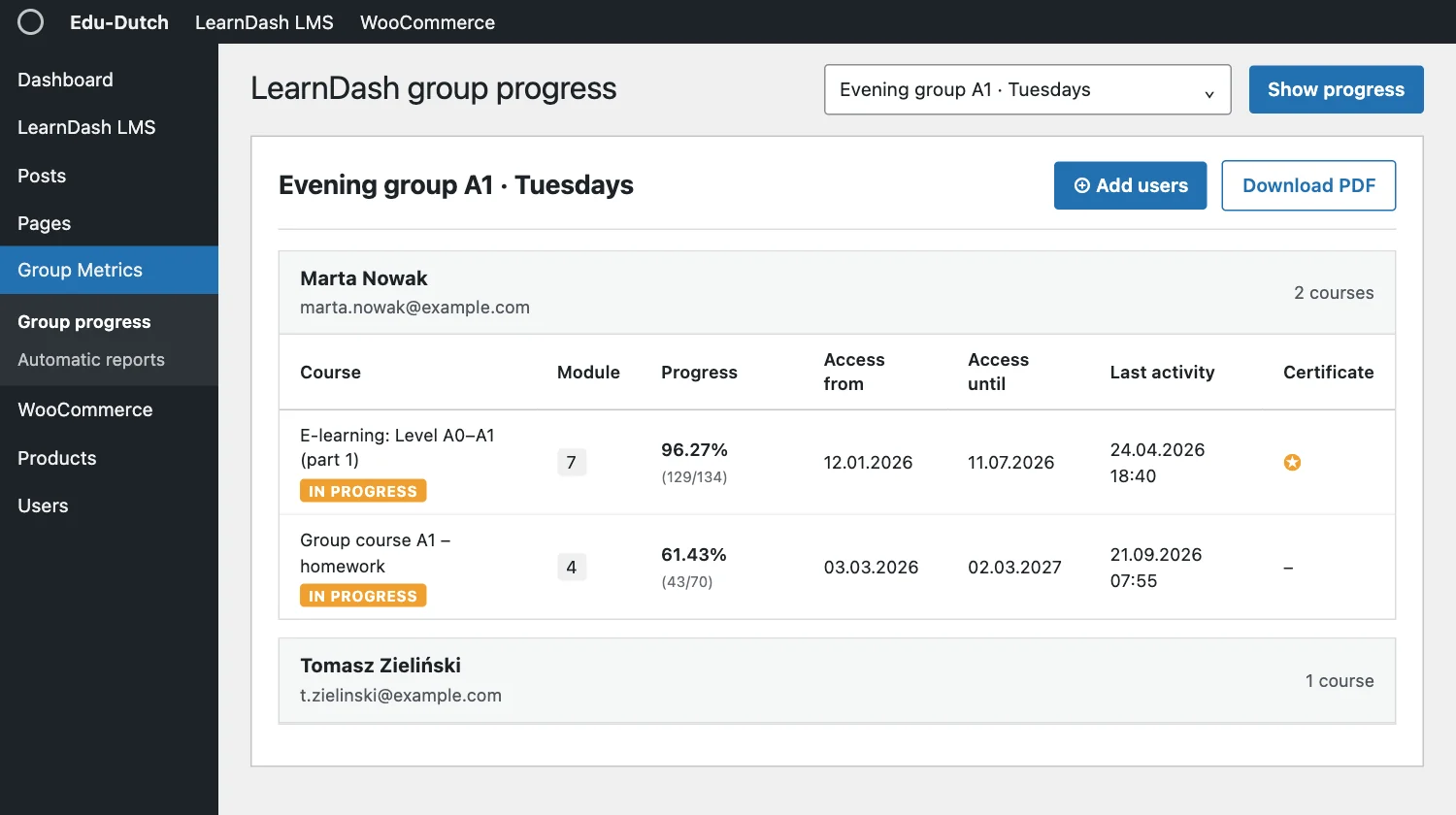
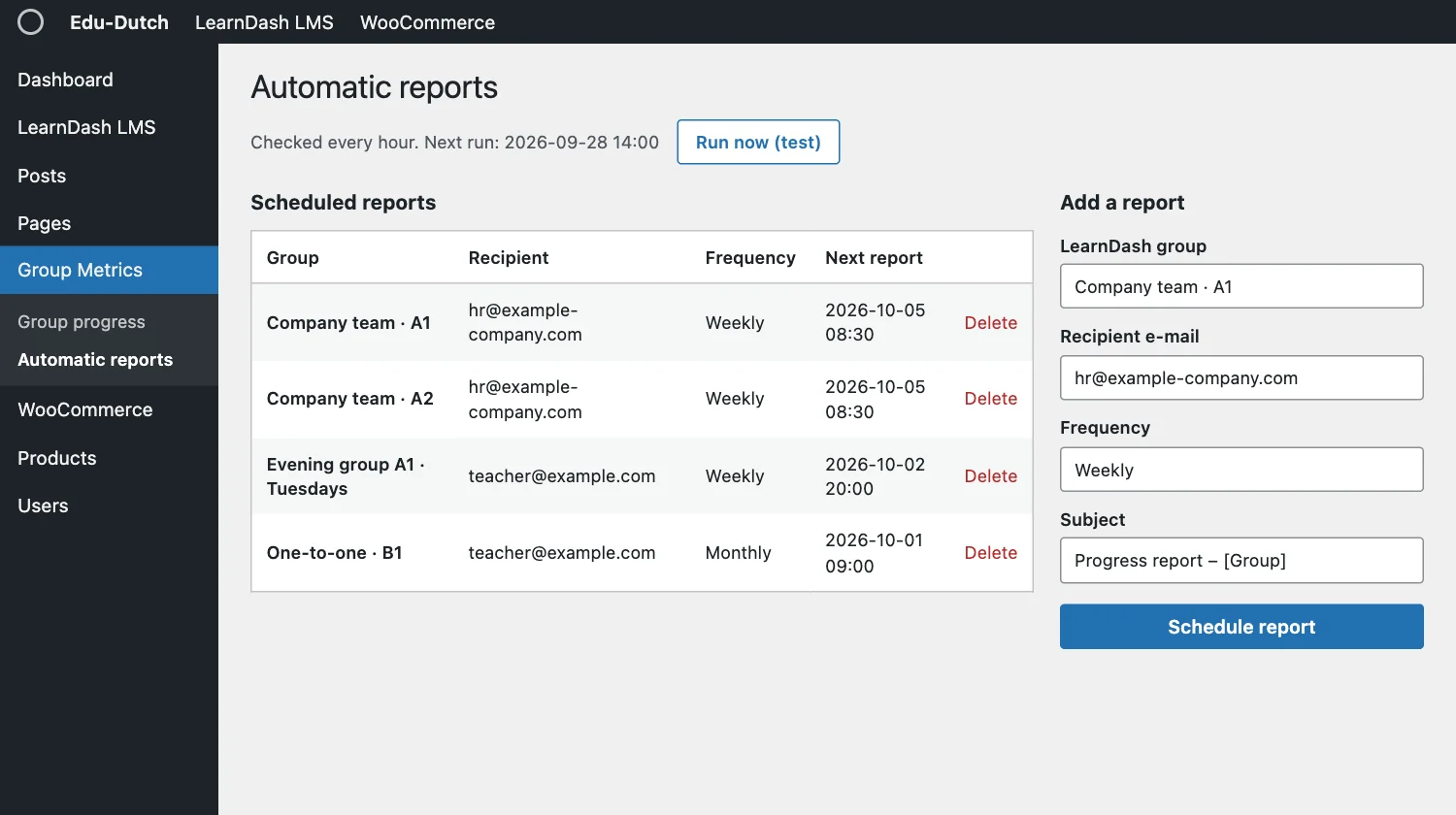
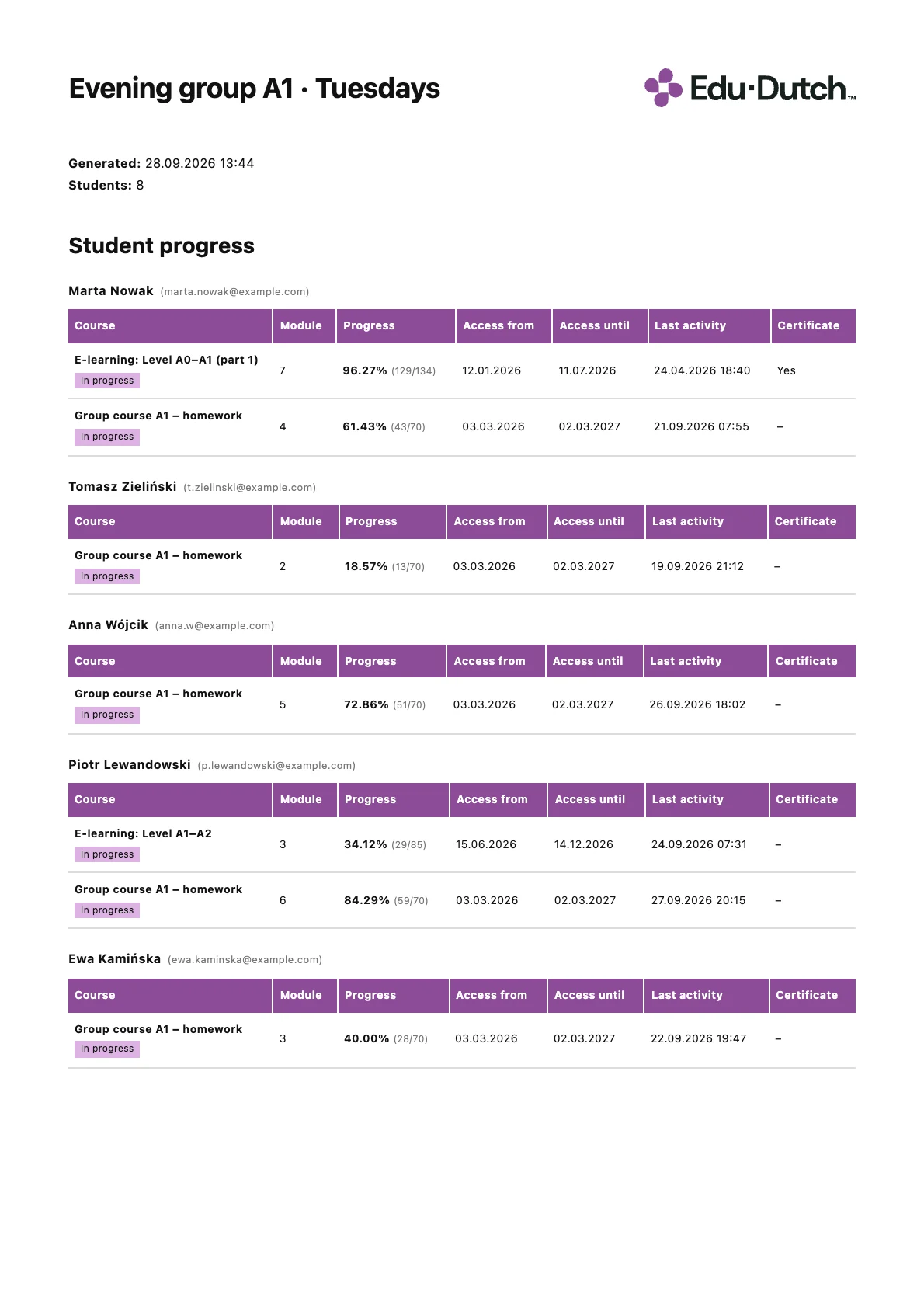
Recreated with demonstration data and English labels.
For each group, the report lists every student’s courses with their progress, access dates, last activity and certificates, and exports it as a PDF in Edu-Dutch’s branding. Reports can also go out by email on a schedule, for example weekly to a contact at a company whose staff learn with the school. After testing the reporting, Kinga said it worked well and asked for it on the Polish platform too: the team expected it to cut down the manual checking of student activity.
Outcome Development answered a specific business need: showing a potential corporate customer what the school could offer.
A new identity on an established platform
In 2026 Edu-Dutch introduced a new visual identity, created by an independent designer Jakub had recommended. The website had to match the social media and other materials the school was already preparing, and the language versions had to look like one brand in front of prospective customers.
Jakub brought the new branding into the existing WordPress platform, starting with a proposal in Figma. The rollout was staged: the English site first, checked there, then the Polish one. The theme changes went live on 18 and 19 April 2026, and Kinga’s feedback was positive. He also suggested a clearer logo mark for small social media avatars and supplied larger files when they were needed.
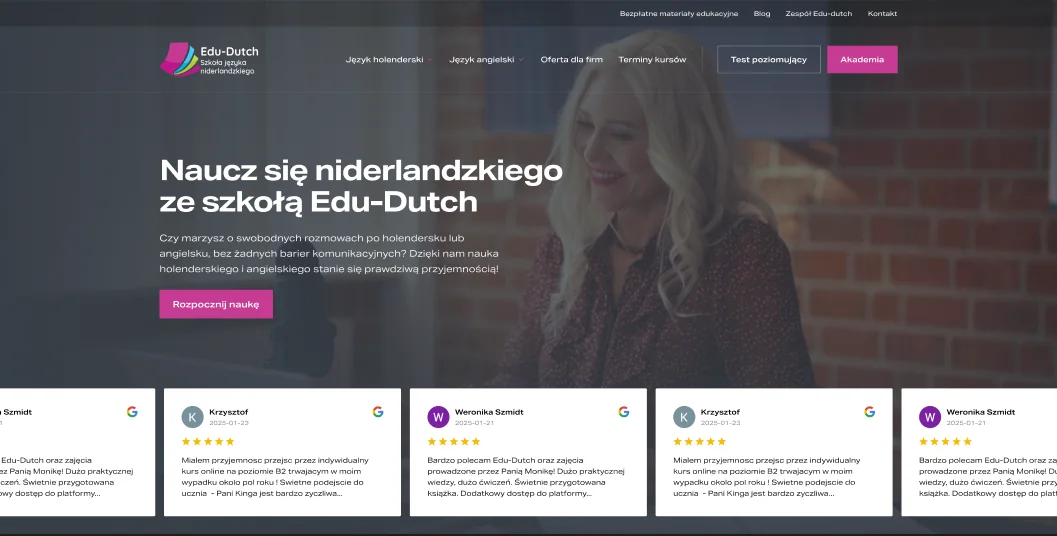
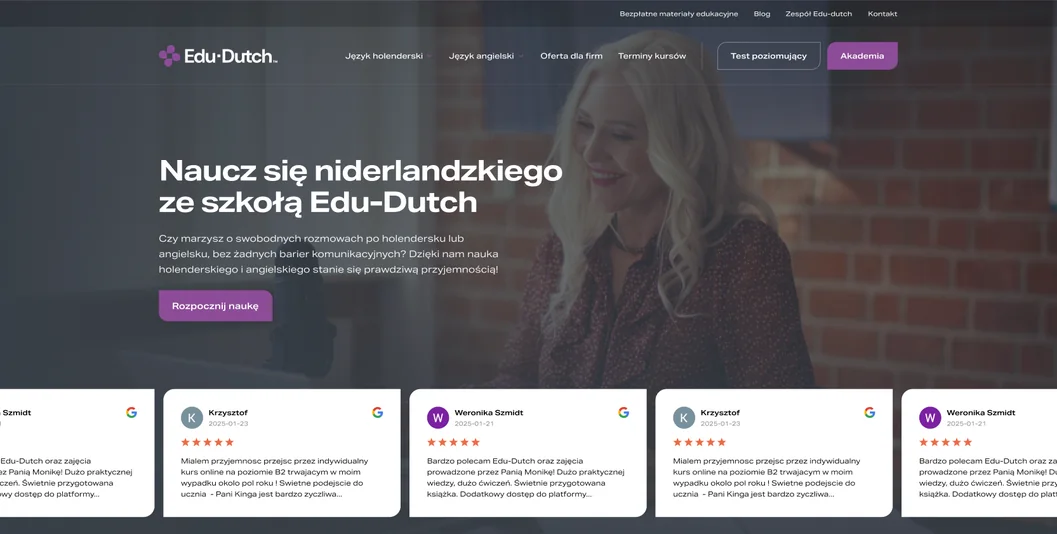
Outcome One identity across the website, social media and supporting materials, applied to the platform the school already had.
Turning analytics into a search plan
Edu-Dutch also wanted to know how people found the school and what would make it easier to find.
The first step was making the data usable. In August 2026 Jakub gave the Polish, English and Dutch sites their own Google Analytics setup (until then they had shared the Polish one) and added all three to Google Search Console. A first analytics report followed, and Kinga’s questions shaped the next step: how to improve the mobile experience, which searches brought people in, and how to reach students who did not yet know the school’s name.
Jakub reviewed the search data with those questions in mind, using AI to support the analysis. The resulting plan for the Polish site gives each key page one search intent, so the homepage, the course overview and the pages for group lessons, one-to-one lessons, self-study, course dates, companies and the blog stop competing for the same queries. It adds technical fixes, including hreflang links between the three language domains, clearer link text and structured data that matches each page, and six blog topics built around questions students actually ask.
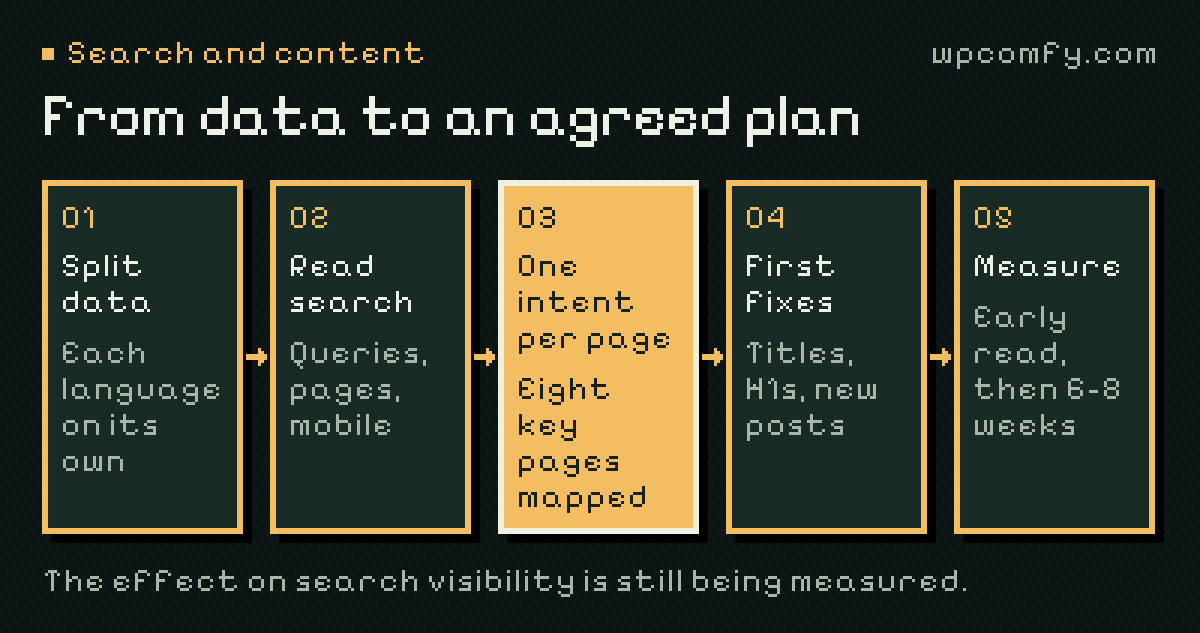
The split of work was clear: Jakub handles the technical side, and the school writes or approves the content, drawing on its teaching experience. By 10 September Jakub had applied the first technical recommendations, updated titles and headings on the main offer pages and published two articles. Kinga reviewed them, including on mobile, and asked for the same treatment for older content, so three existing posts were refreshed next.
Outcome The plan and the first changes are in place. Their effect on search visibility is being measured: an early read after two to three weeks, a fuller one after six to eight.
Support that continues after launch
Edu-Dutch now runs a WordPress and LearnDash platform in three language versions, looked after by the person who built it. Day-to-day issues, hosting questions and the next improvement all go to the same place.
The support after the project was completed is another major strength. Jakub continues to look after our website, taking care of security, updates and new features. We can always count on a quick response, expert help and sound advice.
 Kinga FiebigCo-founder, Edu-Dutch
From her July 2026 review, translated from Polish.
Kinga FiebigCo-founder, Edu-Dutch
From her July 2026 review, translated from Polish.